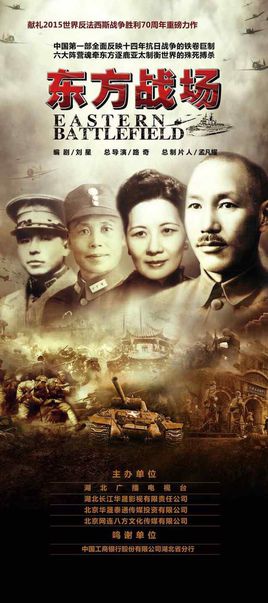
《Oriental battlefield》Ep51:Episode 51 radio wave action
The bombing of Hong Kong streets was followed by the landing of Japanese troops. Hong Kong British defenders surrendered to the Japanese army and the Japanese troops took over Hong Kong. Zhang AiLing and his entourage had to leave for Shanghai. The urgent task for Hong Kong's Eighth Route Army Office to launch contingency plans is to send commandos to transfer cultural and democrats who are stranded in Hong Kong. Taking advantage of the protection of the night, a group of cultural people began a journey of refuge, during which the Japanese patrols were found to be in danger but fortunately escaped the Japanese search safely arriving at their destination. This series of rescue operations have created A miracle in the history of international transfer under the background of war. The Japanese marched toward the United States in Manila, the largest naval base in the South Pacific. The U.S.-Philippine military retreated and suffered heavy losses. MacArthur ordered the retreat to defend the fort and declared Manila an undefended city. The Secretary-General of the Japanese Army's Military Affairs Bureau, Takemoto, clearly understands that the self-expansion of Tojo's British plane was too dangerous for Japan and plotted him to step down. Chi BuZhou was invited to bring his wife, British son, to help the Chongqing radio station to record anti-war speeches. Japanese military aircraft circling over Chongqing were also listening to him. Tellingly, the British son sued in tears the Japanese army atrocities. However, the plane of opportunity for the bombing mission was indifferent. As usual ruthlessly dropped the bomb. Japan Joint Air Raid Command attached great importance to the radio station, strictly forbidding Japanese soldiers to listen to Chongqing radio, intending to destroy this interference Jiang JieShi also took great care of the radio station. In particular, he inquired about the radio host Feng Jian and intended to borrow Feng Jian's hand is boosted by the central government's propaganda influence. In the meantime, Zhou EnLai also delivered a radio speech delivering the Anti-Japanese War rules of "fighting in unity while surviving divisions, winning cooperation and defeating domination." Feng Jian walked long with Zhou EnLai, and Feng Jian's guerrilla broadcasts under various hard conditions were affirmed and praised by Zhou EnLai. Meanwhile, Zhou EnLai proposed to change the name of the radio station. Feng Jian's inspiration decided to call "Voice of China" With Zhou En Lai's support, his radio station is bound to get more and more fire. Japanese Air Force Command shocked the development of Feng Jian's radio station so loudly that Jiang JieShi was to make a radio speech on China Radio. To prevent it from continuing to expand its influence, the Japanese army will perform a high-intensity test of Jiang JieShi's official residence and China Radio Bombing and strangling the diplomatic plot of the Chongqing government. Roosevelt made a speech on China, cheering on China's war of resistance, the brightly lit streets in Chongqing, and people spontaneously organized demonstrations in the middle of the rubble to resist resistance. Song MeiLing invited the long-awaited Song AiLing and Song QingLing to come to Chongqing, breaking the relationship between them. Zhou EnLai instructed that the arrival of Song Sisters is of great significance and instructed Xinhua Daily to report on the incident. Song QingLing delivered a speech and inscribed "Resistance to the End" to show its determination to resist. Roosevelt proposed the joint declaration of common nations and joined all nations in order to win the ultimate victory of the various countries' troops and resources. Song Rover, the U.S. President Roosevelt, the British Prime Minister Winston Churchill, the Soviet Diplomatic People's Committee Levinov and the Republic of China Foreign Minister Song ZiWen gathered together. The United States, Britain, the Soviet Union and China signed the joint declaration of common nations, marking the formation of the international anti-Fascist united front.The Japanese hoof's iron hooves have approached Singapore, Singapore and even the entire Southeast Asia are in precarious situation. The Singaporean Overseas Chinese Association has come into full swing. Chairman Chen Jiageng took the lead in donations. The public responded to the fire and all the people gathered firewood. In order to meet the needs of the war, the anti-fascist allies unanimously agreed to establish the China Theater and Roosevelt appointed General Joseph Stilwell as Chief of Staff of China Theater. Jiang JieShi meets with Stilwell to discuss the issue of fighting in Myanmar. He empowered the theater of command in Myanmar exclusively with Stilwell. A number of Japanese military divisions launched separate attacks on various Burmese ministries and the campaign against Burma thus began. At the request of the British government, China established an expeditionary force and a large number of Chinese troops went to fight in Myanmar. As the situation in Singapore worsens, the city seems to have become an isolated city. As the commander of the Japanese army who attacked Singapore, it was called "Masked General" under the foot of the mountain. Its troops broke the British defenders by a staggering pace, Tan Kah Kee's men came to the letter to advise Chen Jiageng away. At the beginning of the New Year in Singapore, while the enemy on the other side was forcing them to surrender. At this time, the British finally made the wish of the Japanese army surrender to surrender. The Japanese troops stationed in Singapore and Singapore declared their fall. Chen Juegeng paid tribute to the human head of the project, Tan Kah Kee's subordinate bitterly advised him to go to Java Island to avoid the limelight, and Tan Kah Kee has long been captured to death martyred determination, in the face of subordinates to persuade him, he had to give up, stay Aoyama in, not afraid of no firewood. Unexpectedly, there was no small fuss on the way to escape. The motorboat needed to escape had already been requisitioned by the defeated British army. Fortunately, the terminal manager admired Tan Kah Kee's move to rescuet the country from resisting Japan and saving the nation and took the initiative to let the last vessel he used in emergency Motorboat, which solved the urgent needs of Tan Kah Kee. Hideki Tojo fought Southeast Asia to break the blockade of the United States strategic supplies. In order to speed up the settlement of the question of China, he planned to expand the recruitment of troops and preparations for a long-term war. However, the Japanese navy opposed this claim both from above and below and the Navy advocated a quick assembly of Japan Elite aircraft carrier strength and the U.S. Navy battle. When the troops of Yamashita Matsubane captured Singapore and the Indian Ocean gateway opened, the three armies in which the Japanese attacked East India were also rapidly advancing and surrounded by three sides of the most important island of East India. Messy military waves.
![Oriental battlefield(TV)[2016]](https://static.linkeddb.com/images/none.jpg?x-oss-process=image/resize,m_lfit,w_1200,h_360/format,webp "Oriental battlefield(TV)[2016]")


 电影《一个和四个》first青年电影展口碑大爆
 josie ho 纽约影展三片连映:希望将香港电影带出去!
 Ice杨长青《中国说唱巅峰对决》收官,实力演绎多样爆裂舞台
 mingen zhang xujia yan 话剧首演圆满《皮囊》,导演盛赞二人打动人心